How to test a business idea before building
Test a business idea before building: choose a reachable customer, identify a risky assumption and ask about past behaviour. Make a practical first-test plan.
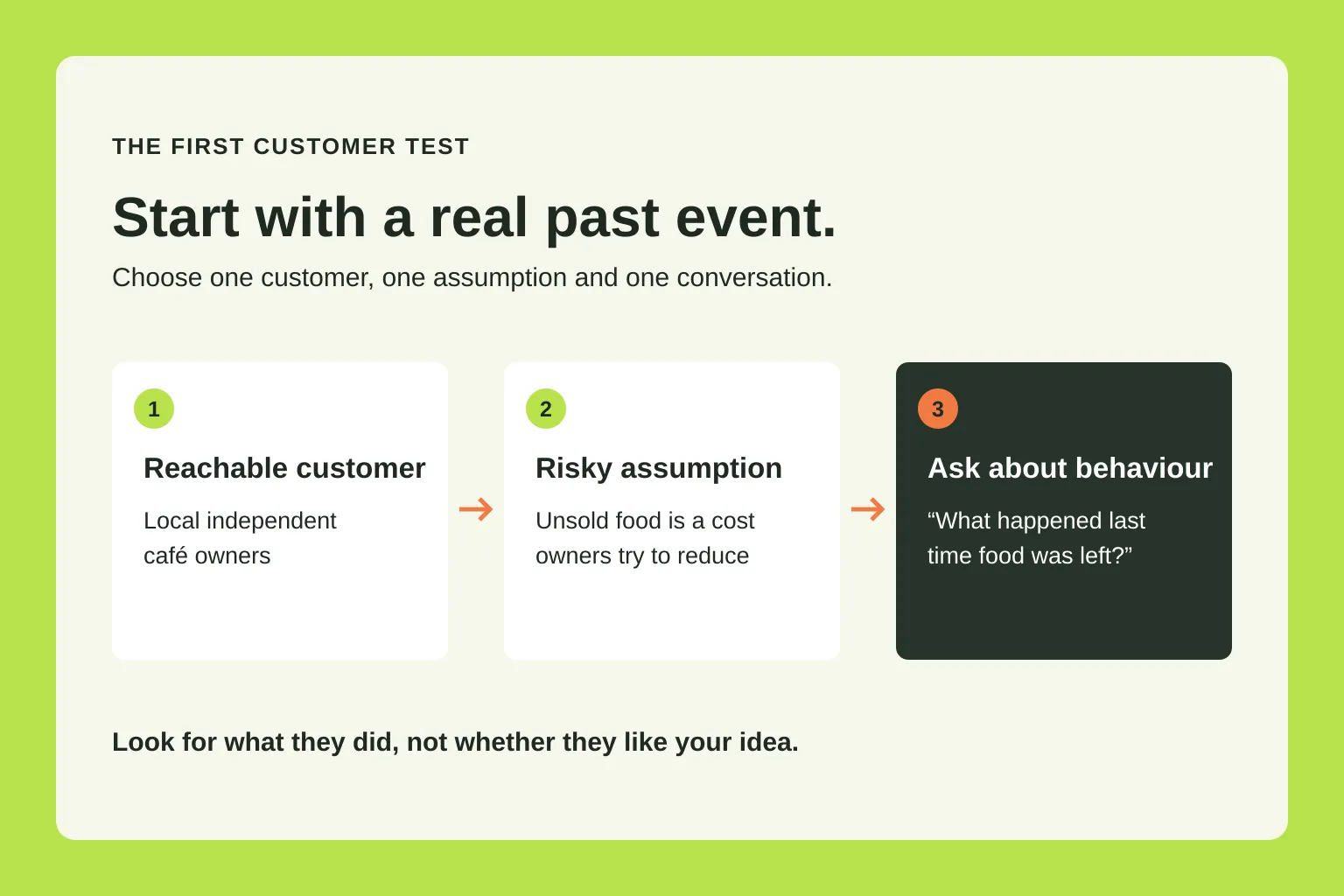
To test a business idea before building, choose a specific customer you can reach, name the assumption that would sink the idea if it were wrong, and investigate it with the smallest useful test. If you don't yet know whether the problem matters, start with a conversation about the last time that person faced it: what happened, what they tried and what it cost. Use what you learn to choose the next test; a friendly reaction isn't proof of demand.
How to test a business idea before building: choose the uncertainty
A risky assumption is something that must be true for your business to work, but that you don't yet have good evidence for. Your first test should address an important unknown, rather than the part you're most excited to make.
Write down what you're relying on: someone has the problem, they care enough to act, you can reach them, they can pay, and you can deliver a useful solution. Then ask: If this were wrong, would I still pursue this version of the idea? Start with a belief where the answer is no and your evidence is thin.
Match the test to the uncertainty:
| What you don't know | A useful first test | What it won't establish |
|---|---|---|
| Does this customer face a meaningful problem? | Ask about a recent event and their current workaround | Whether they'll buy your solution |
| Can they use the proposed approach? | Observe them trying a simple prototype on a realistic task | Whether they'll keep using it |
| Will they commit to a specific offer? | Make a clear, honest offer for a small service you can actually deliver | Whether demand will scale |
| Can you deliver it reliably? | Try the essential work manually on a small scale | Whether the economics work at scale |
If the problem itself is still a guess, begin there. A landing page or prototype can wait until you know what it needs to test.
Choose a customer you can actually reach
Describe people by their situation and behaviour, not just a broad label like “small businesses”. “Independent café owners who decide what happens to unsold food at closing” gives you someone to look for and a relevant event to discuss.
Say you're considering a service that helps cafés reduce unsold food. Before making it, choose a few independent owners you can reach locally. Check that they handle leftovers themselves or know who makes that decision. A barista's experience may help you understand the work, but the owner may control the budget; don't treat those roles as interchangeable.
Make a short list of suitable people and a realistic route to each: a personal introduction, an existing professional connection, or a community where research invitations are allowed. If you can't find anyone who fits, customer access is already an assumption to investigate.
Friends can help with introductions. Their enthusiasm doesn't substitute for conversations with people who face the problem. Business.gov.uk's validation guidance also recommends going beyond friends and family to people who represent future customers.
Ask permission and keep the request specific:
“I'm researching what independent cafés do with unsold food. Could I ask you about a recent closing shift for 15 minutes? I'm trying to understand the current process, rather than sell you something.”
Fifteen minutes is a suggested starting point, not a research requirement. Agree a time that suits them, rather than interrupting a busy shift.
Turn the risky assumption into something observable
For the café idea, “Owners will love my service” gives you little to investigate. Try: “Unsold food is a recurring cost that owners already spend effort trying to reduce.”
That assumption points to evidence you can ask about:
- A recent occasion when food remained unsold.
- What the owner did with it, including doing nothing.
- The cost or effort involved, and how they estimate it.
- Previous attempts to reduce leftovers and why they continued or stopped.
Before the conversation, write down what would make you rethink. For example: if the owners you speak to rarely have leftovers, already handle them easily, or prefer to focus elsewhere, revisit the problem or customer group.
For a manageable first round, you might speak to three owners. That's a planning choice, not a threshold for validation. A few conversations can expose a mistaken assumption or suggest a pattern to investigate; they don't tell you how common the problem is across the market.
Ask about the last time, not whether they like your idea
Start with: “Tell me about the last time you had food left at closing.” Follow the event in order, without pitching your solution. Harvard Business School's Customer Discovery Basics recommends open-ended questions about past behaviour, and warns against leading questions and purchase intentions.
Use these questions as prompts, not a script you must finish:
- “What happened that day?”
- “What did you do with the food?”
- “Who else was involved in deciding?”
- “What did that cost you in money or time? How did you work that out?”
- “What have you tried before? Tell me about the most recent attempt.”
- “What happened next?”
Let an answer change your follow-up. If the owner says leftovers are donated, ask about the last donation and the work involved; don't steer them back towards waste because that suits your idea.
| Instead of asking… | Ask… |
|---|---|
| “Would you use an app for this?” | “How did you handle it last time?” |
| “Don't you hate throwing food away?” | “What happened to the food that remained?” |
| “Would you pay £20 a month?” | “What have you spent on dealing with this so far?” |
| “What features should I build?” | “Where did the current process get difficult?” |
Past spending helps you understand priorities and budgets. It doesn't prove they'll pay you. Asking about actual experience reduces reliance on predictions, but memory can still be incomplete. With permission, a relevant record or a demonstration of their current process can help you understand the account; avoid collecting unnecessary personal or confidential information.
Record evidence separately from your interpretation
After each conversation, write a short note while it's fresh:
- Observed or reported: the event, their words, their actions and any costs they described. Mark estimates as estimates.
- Your interpretation: what those details suggest about your assumption.
- Still unknown: what you need to check next.
“Owner described discounting sandwiches before closing” is a reported action. “Owner needs our service” is your interpretation. Keep them apart so your idea doesn't quietly become its own evidence.
Look for contradictions as well as patterns. Compliments without a concrete event are weak evidence. A painful event with no attempt to solve it needs more investigation: perhaps the owner had no workable option, or perhaps another problem mattered more. Silence after an invitation can reflect timing or access, rather than prove the problem doesn't exist.
Choose the next test from what happened
If you can't find recent examples, change the customer group or investigate a different problem before building. If owners describe repeated difficulty but already have a satisfactory workaround, find out what would justify switching. Don't assume inconvenience alone is enough.
If you find a recurring problem and active attempts to solve it, test a specific solution next. That could mean a manual service you can deliver, or a simple prototype observed in use. State what you're offering honestly, including the price and delivery limits if you're making a paid offer.
A booked follow-up or agreed trial shows more commitment than “sounds great”, but each supports a different conclusion. Even a payment is evidence for that offer in those circumstances, not a guarantee of repeat demand or a viable business.
Make your plan, then take it to a person
Startup Misfits PROOF's free customer-test worksheet lets you write your idea, intended customer, riskiest assumption and next test, then download the plan as a text file without signing in. Download or copy it before closing the page, because unsaved answers stay only in the open page.
Prefer to start alongside other aspiring founders? Separately, you can join the Basecamp interest list for the free five-day live online introduction to the Big Idea Method. Dates and session times are still being confirmed; joining the interest list doesn't reserve an event place.