Customer interview questions for your first idea test
Customer interview questions for a first idea test: ask about past behaviour, follow vague answers and separate reported evidence from your interpretation.
Good customer interview questions ask about a specific past event: what the person was trying to do, what happened, how they handled it and what it cost. Start with “Tell me about the last time you…” and follow their answer rather than presenting your idea. Record what they report separately from what you think it means; a handful of interviews can guide your next test, but isn't proof of demand.
Customer interview questions to ask before you pitch
For a first idea test, a customer interview is a conversation with someone who fits your intended customer group, aimed at understanding their experience. You don't need customers of your own yet. You need people who actually do the activity you're investigating.
If you haven't chosen that group or the assumption you want to investigate, use our guide to testing a business idea before building first. The questions below help once you know whom you're talking to and what you need to learn.
Describe the activity neutrally. For an idea about arranging tutoring lessons, ask about moving a lesson, rather than “the nightmare of rescheduling”. A lesson change might be easy; give the person room to tell you that.
| Ask | Follow up with | Listen for |
|---|---|---|
| “Which parts of [activity] do you handle yourself?” | “Who handles the other parts?” | Whether they do the work, decide, pay, or play another role |
| “Tell me about the last time you [did the activity].” | “When was that? What set it off?” | A particular event rather than a general opinion |
| “Walk me through what happened.” | “What did you do next?” | The sequence, including steps you hadn't expected |
| “Where, if anywhere, did it get difficult?” | “What happened at that point?” | Their difficulty, without suggesting yours |
| “How did you deal with that?” | “What happened after you tried that?” | A workaround and its result, including doing nothing |
| “What time or money went into that occasion?” | “How did you work that out?” | Reported costs, with estimates marked as estimates |
| “Tell me about the previous time this happened.” | “What was different?” | Another event that supports or challenges the first account |
| “Have you tried another way of handling it?” | “Tell me about the most recent attempt. Why did you continue or stop?” | Actual efforts to change, and reasons to keep the current approach |
| “Who else was involved?” | “Who chose or paid for the approach you used?” | The distinction between using something and buying it |
Treat the table as a set of prompts, not a questionnaire to complete. An unexpected answer is a reason to follow a different thread.
Harvard Business School's Customer Discovery Basics recommends open-ended questions about past behaviour and warns against leading questions, pitching and asking about purchase intentions. Teresa Torres's customer-interview guide also recommends collecting a story about a specific past experience.
Open the conversation without asking for approval
Give the person a clear topic, agree how long you have and ask permission to take notes. Ask separately before recording; don't collect private customer details you don't need.
Try this opening:
“Thanks for talking with me. I'm researching how independent tutors arrange lesson changes. I'd like to understand a recent occasion from your point of view. There are no right answers. Is it okay if I take notes?”
Keep your proposed solution out of the opening. “I'm building an app that saves tutors hours” tells them what answer would please you before you've learned what they do.
If they ask about your idea, you can say: “I'm exploring ways to help with lesson arrangements. Before I describe an approach, I'd like to understand how it works for you now.” Answer honestly; don't pretend to be doing unrelated research. If you later discuss a solution, mark where that happened in your notes so you don't mix unprompted accounts with reactions to your pitch.
Follow a vague answer back to an actual event
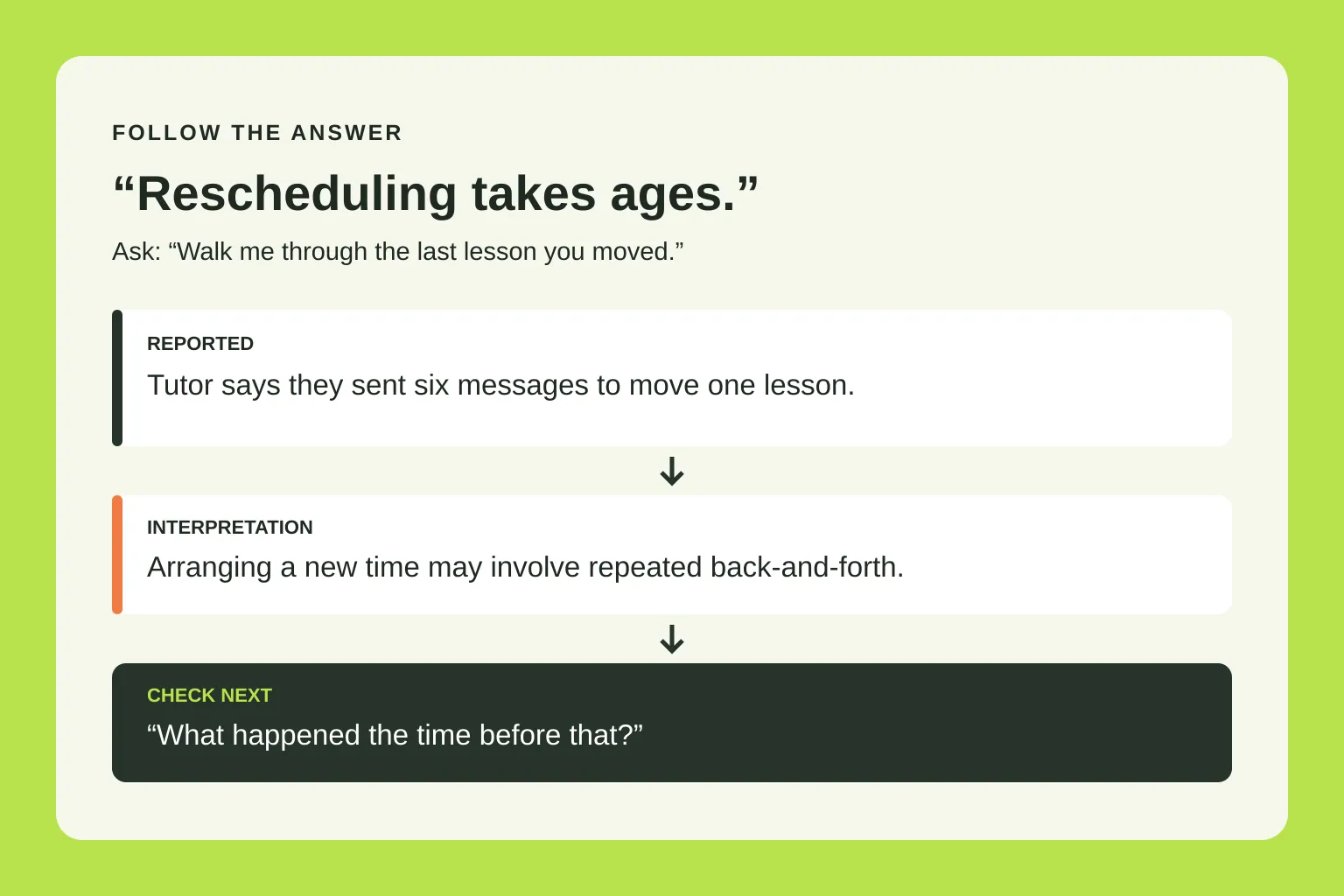
Say you're exploring a service for independent tutors who reschedule lessons themselves. A tutor says, “Rescheduling takes ages.” Don't turn that into “So you'd want automatic scheduling?” Use the tutor's words to find out what happened:
You: “Walk me through the last lesson you moved.”
Tutor: “A parent couldn't make Tuesday. I sent six messages before we settled on Thursday.”
You: “What were you trying to settle in those messages?”
Tutor: “A time that suited both of us. I could only offer two slots.”
You: “What happened the time before that?”
Tutor: “That one was easy. They picked one of the times straight away.”
The second event changes the picture. Perhaps the difficulty comes from limited availability rather than sending messages. That's a hypothesis to investigate, not a reason to build a messaging tool yet.
Use these follow-ups when the conversation drifts:
- “Usually…” → “Can you pick the most recent occasion and walk me through it?”
- “It was expensive.” → “What did you spend on that occasion? Was that a bill or an estimate?”
- “I wish there were an app.” → “What have you done to find another way so far?”
- “Nothing, really.” → “What happened after you left it as it was?”
- “Your idea sounds great.” → “Thanks. Going back to that lesson change, how did you handle it?”
Pause after an answer. Don't offer a list of possible problems to fill the silence. If they can't remember an event, record that and move on; repeatedly prompting until they produce your preferred story weakens what you learn.
Keep reports, observations and interpretations apart
Write notes while the conversation is fresh. Use quotation marks only for words you captured accurately; label a paraphrase as a summary.
For the tutor conversation, your notes could look like this:
| Note type | What to write |
|---|---|
| Reported | Tutor said they sent six messages to move one lesson; the previous change was settled straight away. No message history reviewed. |
| Observed, if shown with permission | What you actually saw in a redacted message thread or demonstration; don't label an account you only heard as observed. |
| Interpretation | Limited available slots may explain the back-and-forth. It isn't clear whether the messaging process itself needs changing. |
| Still unknown | How often difficult changes happen, what time they take, and whether the tutor has sought another approach. |
Past behaviour is still often self-reported. A remembered estimate isn't a measured cost, and a demonstrated process doesn't establish how often everyone else uses it.
Across interviews, keep the people and their contexts visible. “Two tutors described difficult changes; one rarely moves lessons” preserves more information than “Tutors hate rescheduling”. Look for people whose experience contradicts your assumption, including those who are satisfied with their current approach.
Close with permission, then choose what to test next
Finish with “What have I missed about how you handle this?” Then ask whether you may contact them for a clarification or a later test. If another person handles the relevant work, ask whether they would be comfortable making an introduction.
Permission to follow up shows willingness to talk again. It doesn't establish willingness to buy. Avoid ending with “Would you pay for my idea?” and counting a polite yes as demand.
A small round of interviews can reveal a mistaken assumption, a useful distinction between customer groups, or a repeated problem worth examining. It can't establish market-wide frequency, willingness to pay for your offer, or a viable business. If people describe repeated difficulty and efforts to solve it, choose a separate solution or commitment test; if their current approach works well, investigate what, if anything, would justify changing it.
Startup Misfits PROOF's free customer-test worksheet lets you record your idea, intended customer, riskiest assumption and next test, then copy or download a plan without signing in. Put the event you'll ask about and the evidence that would make you rethink in “Next customer test”; keep interview notes separately. Copy or download before closing the page to keep your answers. Worksheet use doesn't join the separate Basecamp interest list or reserve an event place.